


Smart Public Lighting Remote Management: Driving Urban Energy Performance
As part of a comprehensive smart public lighting strategy, remote management is the essential operational building block. For energy syndicates and operators, it is the ultimate control tool to transform a passive electrical network into a responsive and energy-efficient infrastructure. At a time when energy costs are reaching record highs, the ability to control remotely, measure precisely, and react instantly is no longer a technological luxury, but a public management necessity.
What is smart public lighting remote management?
It is essential to start with a clear definition to understand how this system fits within smart public lighting.
Definition and technical scope
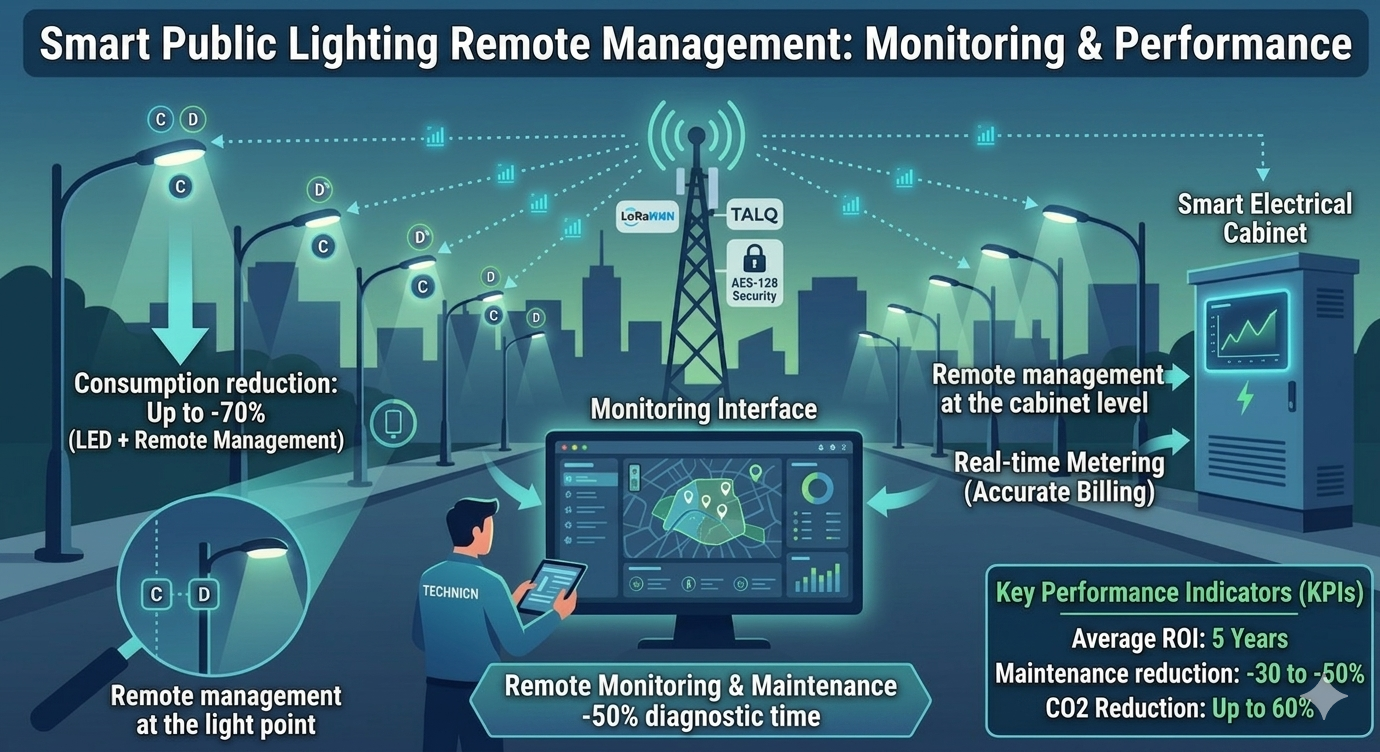
Remote management of public lighting refers to all technological solutions that enable the remote control, operation, and monitoring of lighting points. Unlike a traditional astronomical clock operating in a closed circuit, remote management establishes a bidirectional communication channel between the electrical cabinet (or the luminaire) and a centralized software interface.
The two scales of remote management
Cabinet-level remote management : This allows control of an entire feeder (a street or a district). It is the ideal solution for rapid deployment on existing infrastructure.
Point-level remote management : Each lamppost is equipped with an individual controller. This level offers absolute precision, enabling light intensity to be adjusted fixture by fixture.
Why is remote management the driving force behind smart public lighting?
Switching to connected management addresses economic and operational requirements that traditional methods can no longer meet.
An immediate response to rising energy costs
The control leverage provided by remote management allows real-time action on consumption. For example, a municipality can decide, with a single click, to switch off lighting earlier or increase dimming levels to respond to unexpected budget constraints.
Key figure: Energy consumption can be reduced by up to -70 % when combining LED technology with remote management.
From flat-rate billing to actual metering
For decades, public lighting was billed at a flat rate by energy suppliers. Smart public lighting remote management integrates certified metering modules, enabling energy syndicates to pay exactly for what they consume and putting an end to often overestimated calculations from older systems.
Operational benefits for operators and energy syndicates
For technicians and network managers, remote management radically transforms working methods.
Responsiveness and on-demand control
Remote management offers total flexibility. Whether extending lighting for a festive event or responding to a request from law enforcement for a specific area, operators can adjust schedules without any physical intervention on site. This agility enhances the quality of service delivered to users.
Optimized maintenance and remote diagnostics
Thanks to real-time alerts, operators know the exact nature of a failure (lamp fault, tripped circuit breaker, phase loss) before even dispatching a team.
Time savings: Up to a 50 % reduction in diagnosis and travel time.
Efficiency: Interventions are targeted, prepared with the right parts, and “night patrols” become obsolete.
Digital sovereignty and interoperability challenges
For energy syndicates, choosing a remote management technology is a long-term strategic decision.
The importance of open protocols
In a smart public lighting system, remote management must rely on universal communication standards (such as Lora or TALQ). This ensures that municipalities are not locked into a single vendor and can evolve their infrastructure freely over the next 15 years.
Network security and resilience
Modern remote management uses high-level encryption protocols (AES-128). Data security is an absolute priority to protect critical urban infrastructure from cyber threats.
FAQ: Understanding smart public lighting remote management
Q: What is the difference between remote management and supervision?
Remote management is the technical ability to act on the network (switch on, switch off, dim). Supervision is the software interface that centralizes these commands and analyzes data. In a smart public lighting system, the two are inseparable.
Q: Is remote management cost-effective for small municipalities?
Absolutely. Thanks to significant energy savings and the elimination of physical monitoring costs, even small networks (fewer than 200 lighting points) can achieve return on investment within a few years.
Q: Can remote management be installed on non-LED luminaires?
Yes, this is possible via cabinet-level remote management. However, to benefit from dimming capabilities, switching to LED technology is required.
Q: How does remote management help protect biodiversity?
It allows the precise programming of “dark corridors.” Lighting can be switched off in wildlife crossing areas at specific times while maintaining illumination on nearby roads.
Conclusion: Remote management as a pillar of responsible territorial governance
In summary, smart public lighting remote management is the tool that enables municipalities to move from passive management to an active energy control strategy. By providing full visibility over infrastructure and instant action capability, it secures public budgets and addresses current climate challenges.
For energy syndicates and operators, adopting remote management today means ensuring a high-performing, sustainable infrastructure that is ready for tomorrow’s innovations. Control over light finally becomes an exact science, serving the public good.
This topic speaks to you? Would you like to discuss it with our team?
Write to us today. We’ll be delighted to connect with you and support you every step of the way!
