




Smart Public Lighting: Understanding, Deploying, and Optimizing Urban Networks
Smart public lighting has become an essential strategic lever for local authorities seeking to sustainably reduce costs while improving service quality. In a context where budgets are under pressure and energy prices continue to rise, many municipalities are facing a simple reality: their public lighting represents a significant, and often optimizable, portion of their expenses. Without proper management tools, energy waste, unnecessary maintenance trips, and a lack of network visibility generate avoidable costs. However, some authorities have already made the leap. By using smart public lighting solutions, they have managed to significantly reduce their energy consumption, sometimes by up to 80%, while improving maintenance efficiency and technical team responsiveness. If you are looking to optimize costs, modernize your network, and get a head start on your transition towards a Smart City, this guide provides the concrete keys to understanding and deploying smart public lighting.
Table of Contents
👉 Supervision: The key to smart public lighting.
👉 Public Lighting ROI: A strategic and subsidized investment in 2026?
👉 Remote Management: Driving energy performance in cities.
👉 IoT for Smart Public Lighting: A revolution within local territories.
👉 Smart public lighting: from control at the electrical cabinet to the light points
Understanding Smart Public Lighting
A Strategic Evolution of Urban Networks
Smart public lighting represents a profound transformation in how local authorities manage their lighting infrastructure. Unlike traditional systems, which rely on fixed schedules and global operation, intelligent solutions introduce dynamic control logic.
In practical terms, every light point becomes capable of communicating, being controlled, and adapting its operation based on multiple parameters. Lighting is no longer just an energy expense; it becomes a territorial management tool.
Addressing Contemporary Challenges
Today, local authorities must meet several simultaneous challenges. On one hand, rising energy costs mandate consumption optimization. On the other, environmental goals reinforce the need to reduce CO2 emissions.
Consequently, smart lighting is emerging as the ideal solution to these constraints, allowing for resource optimization while improving the quality of service.
How Does a Smart Public Lighting System Work?
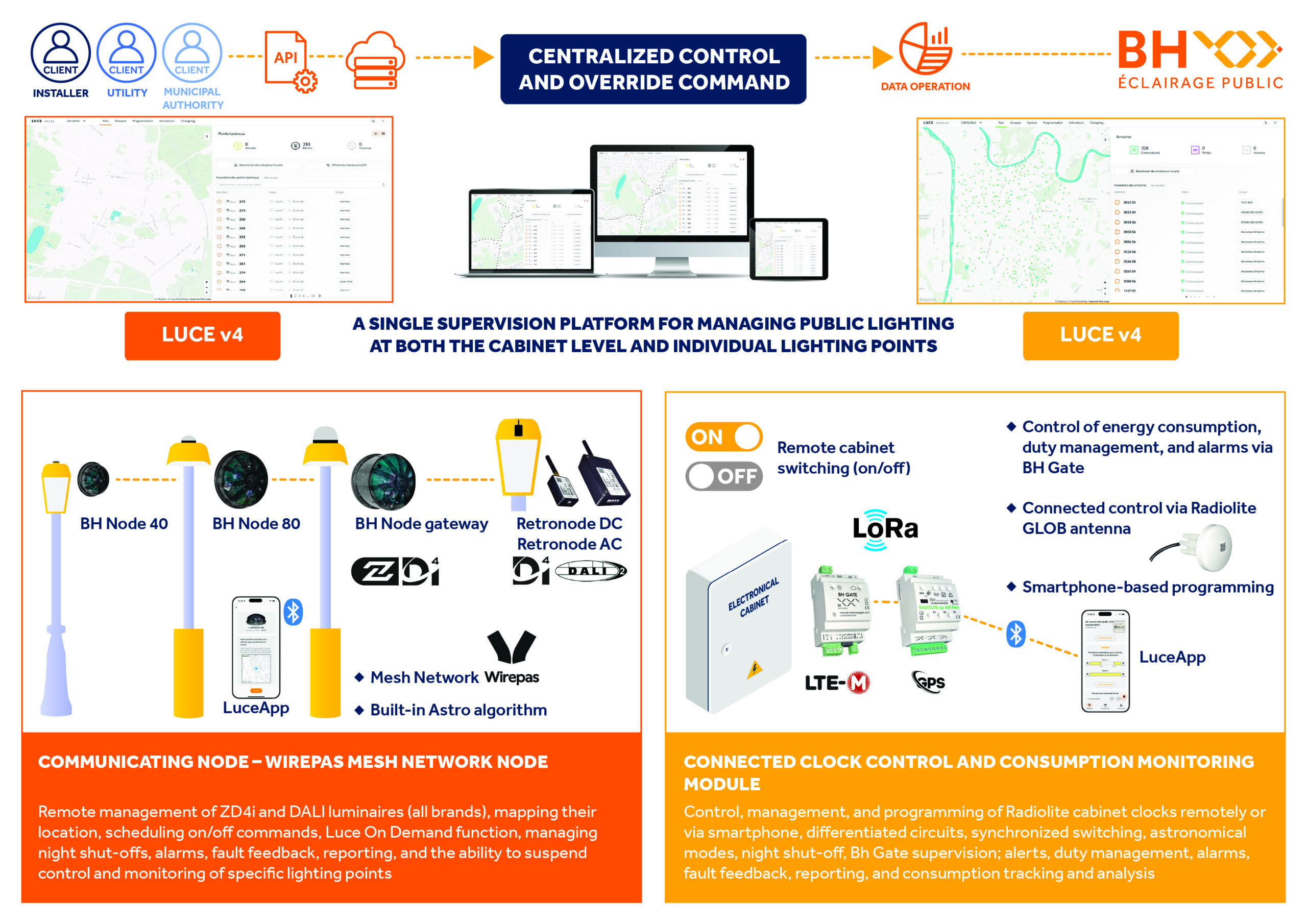
Smart public lighting relies primarily on a connected architecture.
A smart lighting system is based on a structured technological architecture. Connected devices are installed either on the luminaires (light points) or within electrical cabinets. These devices collect and transmit data in real-time.
This data is then centralized in a supervision platform. This interface allows for the analysis of network performance and the remote control of equipment.
The Central Role of Data
Data is the heart of the system. It allows for a deep understanding of network behavior and the identification of potential optimizations.
Thanks to this approach, local authorities can make decisions based on factual evidence rather than estimates.
Benefits for Local Authorities
Significant Cost Reduction
One of the main advantages is the reduction in energy consumption. In many cases, savings can reach between 50% and 80%..
This reduction allows for a quick return on initial investments.
Improved Asset Management
Smart lighting provides better knowledge of the equipment. Collected data facilitates maintenance and the planning of technical interventions.
Enhanced Public Service
Finally, lighting quality is optimized, contributing to improved safety and comfort for citizens.
Local Authority Case Study
Let’s take the example of a municipality with 10,000 inhabitants. Before modernization, its lighting relied on a conventional system.
After deploying a smart solution, the results were significant: energy consumption decreased sharply, as did the frequency of maintenance interventions.
Key Takeaway
Smart public lighting is now an essential evolution for any local authority wishing to optimize its infrastructure.
This topic speaks to you? Would you like to discuss it with our team?
Write to us today. We’ll be delighted to connect with you and support you every step of the way!
